Prioritizing Calls
SmartReach can set the prioritized routing traffic from a certain service (inbound or outbound) or a certain Interactive Voice Response (IVR) exit point. The prioritization system decides call ordering based on a call's numerical priority value, assigned in Messaging, compared to that of other call traffic's priority within the service group (SG). Calls are only prioritized within their SG.
Assigning a Priority to Messages
The priority value, used for determining delivery rank within the SG, is assigned to a service's message. Priority values can range from 1-100. A call with priority 1 will route before a call with priority 2. A call without a defined priority has the default value of 100, and routes after any other higher priority calls.
Set the priority value in the service's message using the Message editor.
- A SmartReach-generated message has the property named "priority." There is only one IVR exit point.
- A message from the Contact Flow might have multiple IVR exit points. Each IVR exit point has its own priority property starting with the name of the agent transfer module. This allows you to preferentially route certain exit points over others (and other traffic). See the image below for an example.
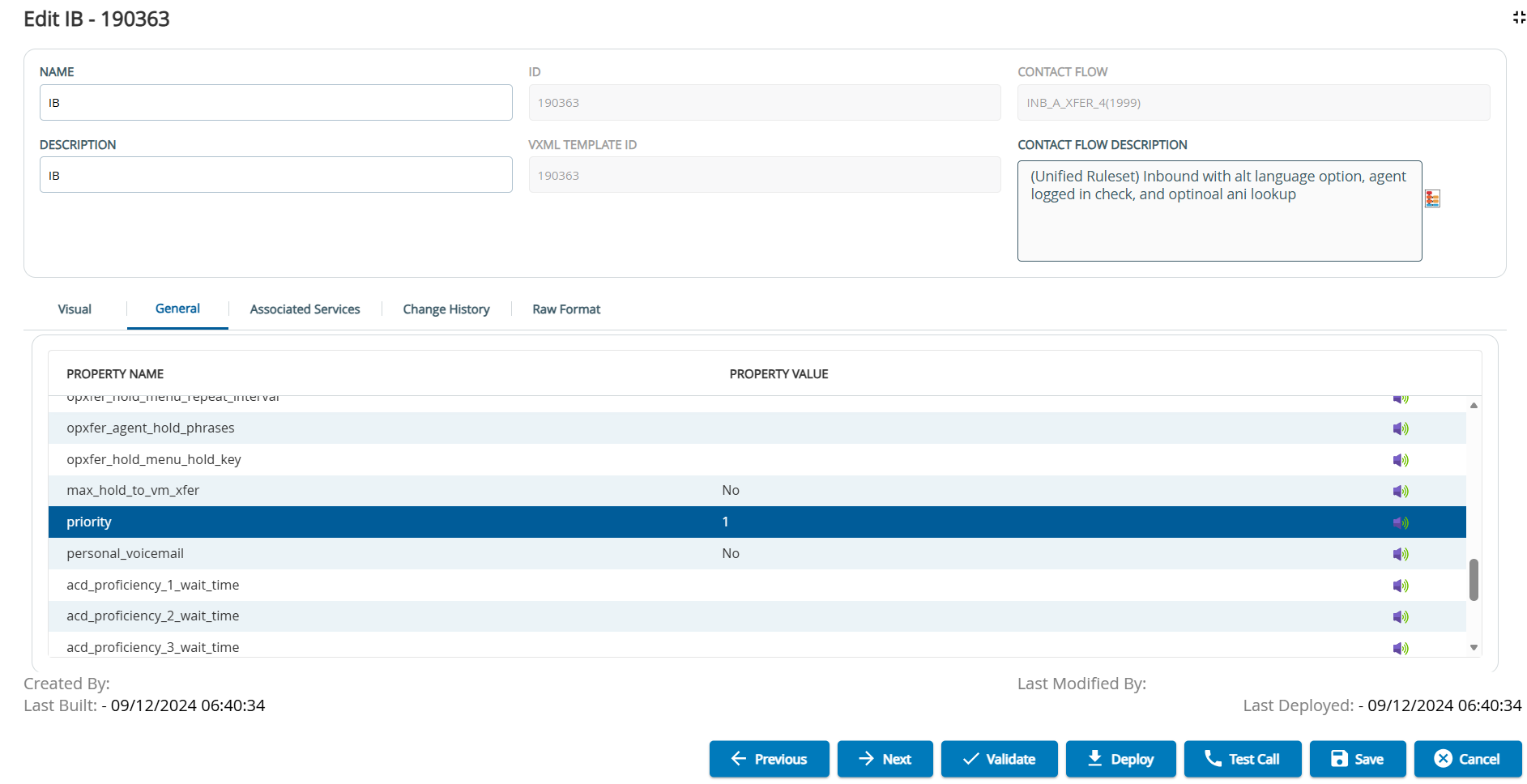

To assign priority to a service's message that does not have a priority property, contact the Customer Care Team to discuss options.
Placing Services in a Service Group
To prioritize traffic, all inbound and outbound sources of traffic that you want to prioritize must be in the Inbound Mapping By Service section of a single service group. All calls in the SG are subsequently ordered according to their priority relative to each other, regardless of where the call came from. In other words, the inbound and all outbound services should be in the Inbound Mapping By Service section and all outbound services should be in the Outbound Mapping By Service section to prioritize inbound and outbound calls. See the Mapping Services Groups for detailed instructions on assigning services in a service group.

It is important to note that services in the outbound side of the service group can receive calls from any services in the inbound side of the service group, including other outbound services. In the following example, QC service 1 can receive outbound calls from QC service 1, outbound calls from RPC service 2, and inbound calls from Inbound service 3.
- Inbound Mapping By service = QC service 1, RPC service 2, Inbound service 3
- Outbound Mapping By service = QC service 1, RPC service 2
Calls are prioritized only within their respective service group. If an outbound service is in more than one queue because it is in the Outbound service group mapping for multiple service groups, SmartReach does not guarantee inter-service group prioritization. In an example where the next call in service group A has priority 100, and the next call in service group B has priority 1, an outbound service shared by both service groups may receive either call next.